For rehabilitation centres in Nigeria
Recovery does not end at discharge.
A client completes your programme and goes home. Everything that held them steady for months, the daily routine, the group, the therapist who knew their name, stays behind at the centre.
Persivera sends part of it home with them. A short check in each morning and evening on their own phone, and one screen back at your centre that shows their therapist who is doing well and who is quietly slipping, while there is still time to pick up the phone.
About us
Built by somebody who sat in the chair.
Persivera was not designed in a boardroom. It was built by somebody who went through a Nigerian rehabilitation programme, walked out at the end of it, and found that the hardest part was only beginning.
The morning routine, the mantra, the prayer, the people who noticed when you had gone quiet. All of it stops at the gate. What replaces it, for most people, is a follow up appointment that is expensive to reach and easy to miss.
Our goal is that no client disappears quietly after discharge. Not because anybody forgot them, and not because the centre stopped caring, but because there was no practical way to stay in touch once they were three hundred kilometres away.
We build the tool that closes that distance. Your programme, your standards, your staff, carried on a phone. We are Nigerian, we work with Nigerian centres, and we understand what a follow up visit actually costs a family here.
The problem
The months after discharge are the hardest to see.
Your centre already knows how the ones who come back are doing. They sit in front of a therapist on whatever schedule you set, and their face can be read.
The difficulty is everybody else. Clients go home to their own cities and states, and a follow up visit turns into a day of travel and a cost the family has to justify. Attendance thins. Then it stops.
When somebody goes quiet there is currently no way to tell the difference between a client who is doing well and simply busy, and one who is in trouble. Both look identical from the centre. The answer usually arrives as a readmission.
This is not a gap in your care. It is a gap in the tools available to you.

- Distance
Clients discharged to other cities and states cannot easily keep returning.
- Cost
Every follow up visit carries transport, a day of work lost, and a fee.
- Silence
A client who stops attending sends no signal until something has already gone wrong.
- No record
Outcomes cannot be shown to a family, a referrer, or anybody who asks.
How it works
Three things, and none of them are complicated.
- 1Set them up before they leave
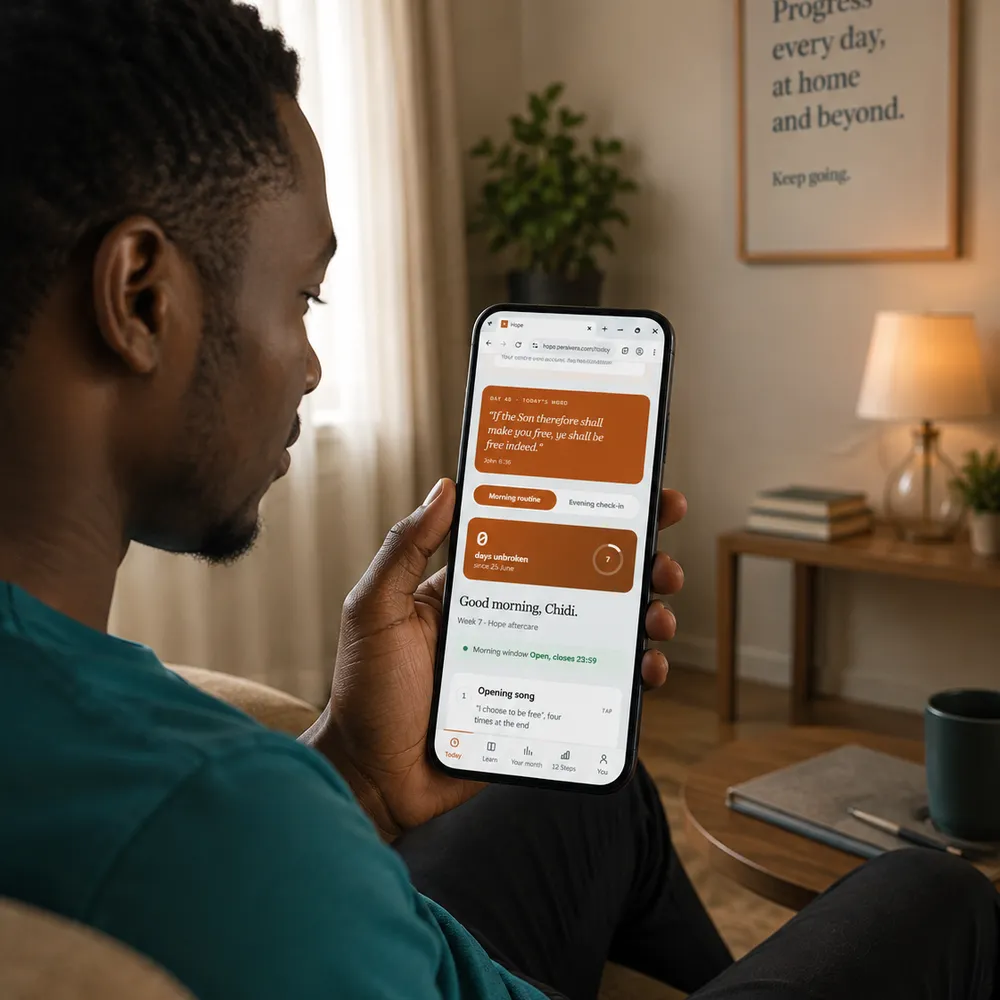
On the day a client is discharged, their therapist creates their account with the client and whoever is collecting them there in the room. It takes about four minutes. The client picks their own password on their own phone, so it works the moment they get home.
- 2They answer a few questions, twice a day
Each morning and evening the app opens for a short while. It walks them through your centre's own routine, then asks how strong the cravings are, whether they came close to using, and what they managed to do that day. Under a minute. If they miss the window, it stays missed, so nobody can fill in a week of answers on a Sunday night and call it a record.
- 3Their therapist sees it building up
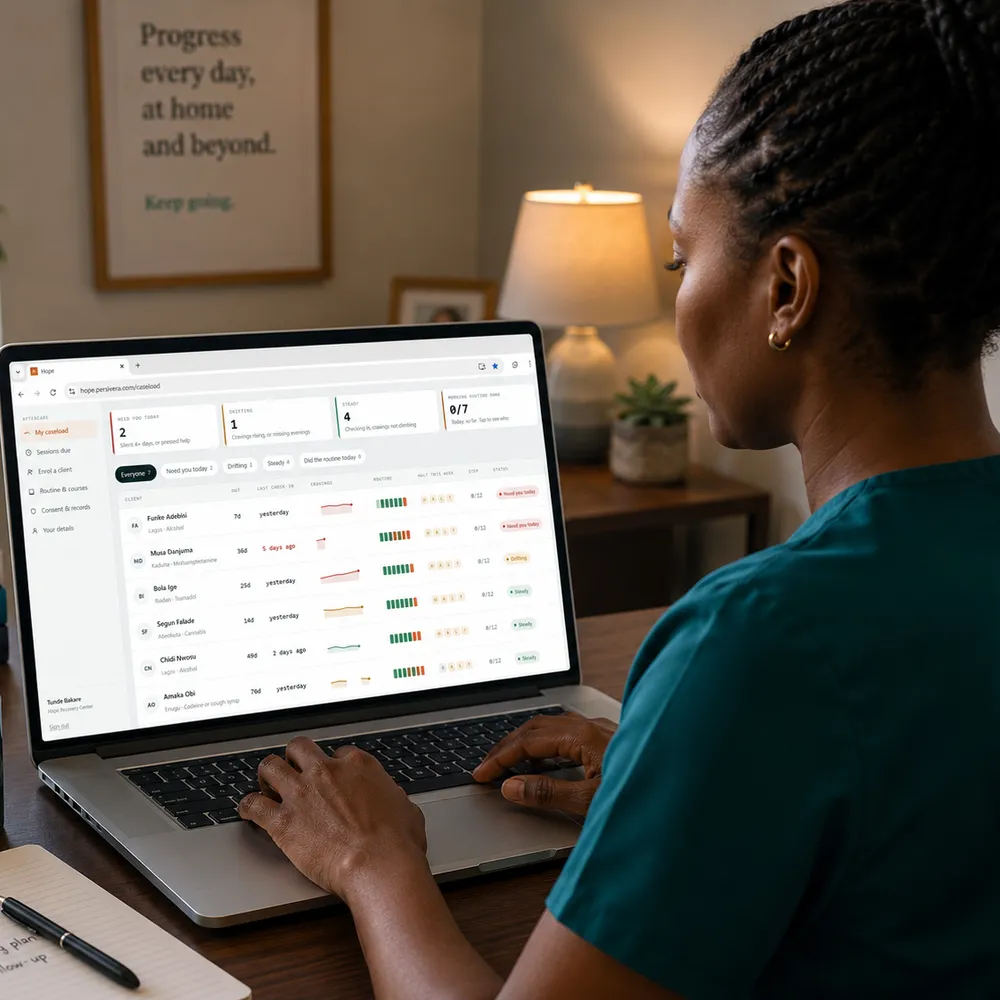
Every answer becomes a point on a line. Over two weeks that line shows whether somebody is settling down or working themselves up. Your therapist opens one page and sees the whole caseload at once: who answered today, whose cravings are climbing week on week, and who has gone silent. The people who need attention sit at the top, so a call gets made in the week it matters instead of after a readmission.
What your therapist sees
One screen, ordered by who needs you first.
Each line is seven days of that client’s craving scores. Where a line stops, nobody has heard from them. That gap is the entire reason this exists.
My caseload
Five discharged clients, sorted by who needs you first.
Illustrative data.
For your centre
What it changes, in practice.
You can tell the family of a ward leaving your care that you follow them for twelve months, every day, and then show them exactly how.
You see rising cravings and missed check ins while there is still room to act, instead of learning about it at readmission.
A real record of how your clients do after discharge. Most centres in Nigeria cannot currently produce that for anybody who asks.
A client who went home to another state stays in contact with the therapist who actually treated them, without a day of travel.
Your name on the door
Your clients never see our name.
The app your clients install carries your centre’s name, your colours and your own recovery programme. Your mantra, your prayers, your course material, released week by week at the pace you already teach it.
It lives at your own address and the icon on their home screen is yours. We do not contact your clients, market to them, or appear anywhere in what they see.
Persivera is the engine, not the sign on the door.
What you can tell a family
“We follow your ward for twelve months after they leave, every single day.”
And then show them how. That sentence is worth more than any feature on this page.
Privacy and records
Health records, handled as health records.
Every client signs a written consent before anything is recorded, in plain language, naming exactly who can see what. Your centre remains the owner of its data. Under the Nigeria Data Protection Act a client may request a copy of everything held about them, or ask for it to be deleted, and both of those are buttons your staff can press.
Those boundaries are enforced inside the database itself, not by the screens drawn on top of it. Nobody outside that table sees anything. Family are not given access and are not told when somebody stops checking in, because everyone on the programme is an adult and the decision about who to call belongs to your clinicians. A client who believes his father can read his scores stops telling the truth, and then the data is worth nothing to anybody.
Read the full privacy policy · where it is kept, how long, and how a client gets a copy or has it erased
Persivera is not a crisis line and is not monitored around the clock. Anyone in immediate danger should ring 0800 000 2673, free, 24 hours, or go to the nearest hospital.
Getting started
Set it up in your centre’s name.
We configure the platform around your programme, not the other way round. Your routine, your materials, your follow up schedule, your staff structure. You decide which of your discharged clients to begin with, and how many.
The first conversation takes about twenty minutes. Bring what your follow up looks like today, and we will tell you honestly whether this helps.